


Unpacking Biases and Building Relationships
In the place now called Australia, the general interest in Indigenous peoples ways of being, doing and valuing has not been higher in the last 235 years. This burgeoning interest in Indigenous systems is a double-edged sword; sometimes a good thing can be done badly. Cultural training,
specifically the rush to training non-Indigenous people about the range of Indigenous cultures in Australia, is an example of this conundrum. This poor practice is understandable, given popular portrayals of invasion and the on-going colonial project makes it difficult for non-Indigenous
peoples, particularly settler-colonialist’s, to see the systemic nature of colonialism’s erosion of Indigenous ways of being, doing and valuing.
It is paradoxical to train individual’s in cultural awareness while the prevailing political, legal, economic and social systems seek to ‘disappear’ those same cultures. The consequences for the provision of cultural awareness services under these circumstances is that the training either
grapples with the legacy of invasion and on-going colonisations before getting to the cultural awareness element. Alternatively, there is the choice to not engage with history and consequent status quo, meaning that the associated cultural training can only be superficial and ultimately
ineffectual.
We believe this conundrum can be avoided by “decolonizing your mind” before seeking to understand those cultures deeply negatively altered by colonization. Requiring settler-colonizers and other non-Indigenous Australian’s to develop an awareness of the ongoing influence of the
colonial project on systems and them as individuals is an important first step toward being prepared to meaningfully engage with cultural awareness training and, more importantly, work with Indigenous peoples and organizations.


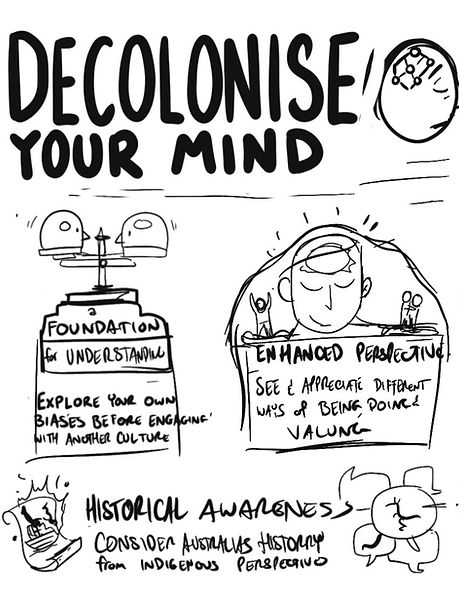
Why decolonise your mind?
Can’t get good grip of another culture if have no awareness of your own.
Increased capacity to see, and respond to other ways of being, doing and valuing.
To consider ‘Australia’s’ history from different perspectives.
Why a series of workshops?
Give time to think/work through each topic, all are a bit heavy going.
Help foster group dynamic that supports the (mostly emotional) work to be done.
Time to do homework.
Benefits
Develop confidence and skills in working with respectfully and effectively with First Nation groups.
Knowledge and understandings to support development of less ‘race-blind’ policy, or at least understand why need to develop such policy
MEET THE TEAM
Session One - White Privilege and White fragility
This session, founded in the recognition that societal power dynamics, structures and institutions perpetuate the white supremacy framework, focusses on two specific resultant behaviours: white privilege and white fragility. Addressing white privilege and white fragility is essential to understanding, identifying and addressing systemic racism.
Session Two - Allyship – Accomplice – Co-conspirator continuum
Building on the first workshop, this session helps participants identify where they currently are, and where they might like to be, on the allyship-accomplice-co-conspirator continuum of solidarity with Indigenous peoples. Essentially these terms refer to different levels ofengagement with Indigenous communities and nature of participation.
Session Three - Positionality Statements
Positionality statements are self-reflexive exercise that allow acknowledgement of personalbiases and reflection on how they may influence the conduct or priorities of a research project, community consultation process or policy development. Positionality statements could also be used to recognise any conflicts of interest arising from engaging with the community due to cultural or political differences.
Session Four - On Country, Ngunnawal Voices, truth-telling
Truth-telling by First Nations People is vital for non-Indigenous peoples understand their lived experiences and our shared history. It is crucial to ensure that Ngunnawal stories, knowledge, and culture are not ignored, whitewashed or forgotten over time.
Nicola Lambert
Nicola is an Irish Women, relational facilitator, creative producer, and systems-weaver who has lived and worked on Ngunnawal Country for over sixteen years. Through Catchment Studio, she walks alongside Ngunnawal Custodians and communities to centre Country, story, and cultural authority in environmental and organisational practice.
As co-creator and non-Indigenous facilitator of Decolonise Your Mind, Nicola supports participants to unpack the systems that shaped them — privilege, bias, fragility — and prepare to meet Ngunnawal truth-telling with respect and readiness. Her approach is embodied, reflective, and grounded in slow, relational processes that make genuine transformation possible.

